
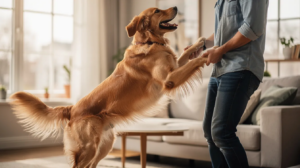
Dogs may jump on people for several reasons, including excitement, anticipation, social contact, stress, and a history of receiving attention for the behavior. Jumping is one of the most common concerns dog owners experience, but it is generally not evidence of defiance or an attempt to dominate a person.
This article explains why jumping occurs, which situations commonly trigger it, and how dog owners in Winston-Salem and beyond can encourage safer, more polite greetings. Whether you have an enthusiastic puppy or a large adult dog that could knock someone down, management and consistent practice can make everyday interactions easier.
The short answer: Dogs often jump because they are excited to interact and have learned that placing their paws on people produces attention. Some dogs may also jump when they are overstimulated, frustrated, or uncertain. Understanding the context helps owners choose an appropriate response.
By reading this article, you will gain:
- A clearer understanding of why dogs jump on people
- Help identifying situations that increase jumping
- Practical, reward-based methods for teaching polite greetings
- Management strategies for protecting visitors during training
- Guidance on when professional help may be appropriate
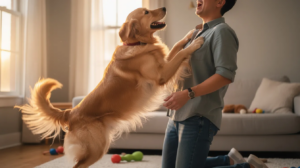
Understanding Dog Jumping Behavior
Jumping commonly occurs during social interactions. A dog may be trying to get closer to a person’s face or hands, initiate contact, or release excitement. However, jumping alone does not reveal the dog’s exact motivation. Owners should consider what happened immediately before the behavior, what response followed it, and what the rest of the dog’s body is communicating.
Social Behavior and Canine Communication
Dogs use posture, movement, facial expressions, vocalizations, and physical contact to communicate. Some dogs jump during greetings because doing so brings them closer to a person and frequently results in interaction.
Young dogs may also show strong interest in faces. Puppies use close facial contact when interacting with their mothers and littermates, but this does not prove that jumping on people is simply a direct continuation of food-solicitation behavior. Excitement, learning history, and the immediate environment can all influence the behavior.
A loose body, relaxed facial muscles, and broad movements may accompany friendly excitement. A wagging tail by itself, however, does not always indicate that a dog is comfortable. A stiff posture, tucked tail, avoidance, freezing, repeated lip licking, or difficulty recovering may suggest stress or uncertainty.
Jumping that begins in puppyhood can continue into adulthood when it repeatedly leads to petting, play, conversation, or other valued responses. What is manageable in a small puppy can become a safety concern when performed by a larger adult dog. Early puppy training can help owners establish clearer greeting routines before jumping becomes well-practiced.
Learned Attention-Seeking Patterns
Dogs quickly learn which behaviors produce useful outcomes. If jumping results in petting, eye contact, verbal attention, or play, it may become more frequent. Even pushing a dog away or repeatedly saying “down” can function as attention for some dogs.
Inconsistent responses can make jumping more persistent. If one person rewards four paws on the floor while another pets the dog for jumping, the behavior may continue because it still produces attention occasionally.
A 2017 observational study by Řezáč et al. reported associations between jumping behavior and several dog, owner, and walking-related factors. However, the study did not establish that reinforcement history with particular people directly caused the observed behavior.
Jumping may become more established after months or years of practice, but that does not automatically mean professional behavior modification is required. Many owners can make progress by preventing rehearsal, rewarding an appropriate alternative, and keeping household responses consistent.
Common Jumping Situations and Triggers
Identifying when and where your dog jumps can help you build a more targeted training plan. Common triggers include the doorbell, arriving visitors, an owner returning home, preparations for a walk, and encounters with unfamiliar people.
Greeting Visitors at Home
The front door is a common location for jumping because several exciting events happen at once. The doorbell or knock creates noise, people move toward the entrance, and a visitor enters the dog’s environment. These events may increase anticipation and arousal.
Jumping can startle visitors or cause someone to fall. The risk is greater for children, older adults, people with limited balance, and anyone who is uncomfortable around dogs. Large and powerful dogs should be prevented from reaching visitors until the handler can conduct a controlled greeting.
Use a leash, gate, exercise pen, separate room, or additional distance while the visitor enters. Management protects the visitor and prevents the dog from repeatedly practicing the unwanted behavior.
Encounters During Walks and Public Spaces
Jumping during walks presents a different challenge. Excited dogs may jump because of heightened arousal, anticipation, playfulness, or a history of being allowed to greet people that way.
The 2017 Řezáč et al. study found associations between jumping during walks, sex, and walking frequency in the dogs surveyed. However, the observational findings do not establish why those associations occurred or prove that frequent walks caused dogs to practice more jumping.
Beyond the training challenge, jumping can create safety and potential liability concerns if a dog knocks someone down or causes an injury. However, jumping alone does not automatically make a dog legally “dangerous,” and applicable rules depend on the jurisdiction and circumstances.
Even friendly behavior can frighten strangers or injure children, older adults, and people with limited balance. This is why obedience training that generalizes to public settings can be valuable.
Owner Return and Daily Interactions
Anticipation before walks and excitement when owners return home are common contexts for jumping. Research published in 2024 found that 73% of the surveyed dogs had jumped on household members before a walk at some point in their lives.
Dogs walked less than once per day were more likely to have displayed the behavior than dogs walked more frequently. These findings show an association with the pre-walk context but do not prove that anticipation alone causes jumping.
Jumping can occur during friendly excitement, but it may also appear when a dog is conflicted, stressed, or uncertain. Look at the complete body rather than the jumping alone. A lowered posture, tucked tail, avoidance, freezing, repeated lip licking, or difficulty recovering may suggest that stress is contributing.
Dogs displaying persistent fear or anxiety may need veterinary assessment or guidance from a qualified behavior professional rather than a greeting exercise alone.
Training Methods and Implementation
Effective greeting training combines prevention with reinforcement of a behavior the dog can perform instead of jumping. Veterinary behavior guidance generally supports teaching desired behavior through appropriate rewards while avoiding fear, intimidation, and unnecessary confrontation.
Four-Paws-on-the-Floor Training Protocol
The four-paws-on-the-floor approach teaches the dog that remaining grounded produces treats, attention, or access to a greeting. A trained sit can also be used, although some dogs find it easier to keep four paws down than to hold a sit during exciting interactions.
Follow this protocol:
- Prevent the dog from reaching the visitor while jumping. Use a leash, gate, exercise pen, or additional distance when necessary. Avoid pushing, shouting, or turning the interaction into physical play.
- Reward the calm approach before jumping occurs. The moment your dog has four paws on the floor or offers a sit, mark the behavior with a click or verbal marker and provide a treat or calm attention.
- Pause attention when jumping occurs. If it is safe, the person can turn slightly away or step back while the handler guides the dog away. Resume the greeting when the dog returns to the desired position.
- Practice controlled greetings with family members. Have family members take turns entering and exiting while rewarding the same alternative behavior.
- Increase difficulty gradually. Add knocking, the doorbell, bags, or carefully selected practice visitors only after the dog succeeds with calmer entrances.
Everyone who regularly interacts with the dog should use the same general protocol. Consistent reinforcement helps the dog understand which greeting behavior produces access to people.
Training Method Comparison
Different approaches may be appropriate for different dogs and households.
| Criterion | Four Paws or Sit | Time-Based Reinforcement/NCR | Management With Leashes or Barriers |
| Evidence | Widely used to reinforce an alternative greeting behavior | A small single-case study reduced jumping in three of four dogs | Immediately limits opportunities to reach people |
| Timeline | Varies by dog, reinforcement history, and practice | Varies and may require professional guidance | Works only while the management tool is in place |
| Consistency | All regular handlers should reward the same behavior | Requires a planned schedule and correct reinforcer selection | Requires reliable setup before greetings |
| Best Use | Teaching the dog what to do instead of jumping | Cases where a qualified professional identifies the function of jumping | Protecting visitors and preventing rehearsal during training |
| Limitation | Does not become reliable without repeated practice | Evidence is promising but based on a small sample | Does not teach an alternative behavior by itself |
The cited non-contingent reinforcement study involved five dogs during functional assessment and four during treatment, so its findings should not be generalized to all dogs.
For many dogs, a practical approach combines reward-based training with management. Use a leash or barrier to prevent jumping during greetings while rewarding four paws on the floor or another appropriate behavior.
A 2026 Frontiers in Veterinary Science paper summarized evidence associating reward-based training with favorable welfare outcomes and fewer behavior concerns than aversive methods, while also noting limitations in the available research. It did not establish a guaranteed timeline or outcome for jumping treatment.
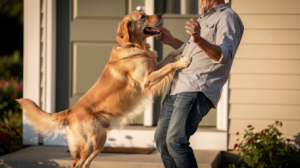
Common Training Challenges and Solutions
Training may progress smoothly in a quiet room but become more difficult when visitors, movement, unfamiliar environments, or other distractions increase arousal. Management remains important while the dog learns to respond in more challenging situations.
Inconsistent Family Member Training
Inconsistency among household members is a common obstacle in greeting training. If one person rewards calm behavior while another laughs and pets the dog when it jumps, the behavior may persist because it still produces attention occasionally.
The Merck Veterinary Manual’s behavior modification guidance explains that intermittent reinforcement can make an established behavior more resistant to extinction.
Solution: Agree on one greeting routine for the household. Ask family members and planned visitors to wait for four paws on the floor or another trained behavior before interacting with the dog. A reminder near the entrance can help everyone follow the same procedure.
For households struggling to implement a consistent plan, private dog training can provide individualized guidance.
High-Excitement Situations
Holiday gatherings, running children, multiple visitors, and unexpected encounters can make it difficult for a dog to remain responsive. Spinning, barking, pulling, frantic movement, or an inability to take food may indicate that the situation is currently too difficult.
Solution: Use gradual practice and management before anticipated triggers. A calm sniffing walk, appropriate play, a food puzzle, or a rest period may help some dogs settle, but avoid exhausting the dog or creating more arousal immediately before guests arrive.
Begin with one calm practice visitor and increase difficulty only when the dog can remain responsive. Use a leash or barrier to prevent jumping without physical confrontation. Progress varies, and some dogs will continue needing management in highly stimulating situations.
Large-Dog Safety Concerns
When a large or powerful dog jumps on a person, the force can knock someone down and cause an injury, particularly to children, older adults, or people with limited balance. Immediate management is important while the dog learns a safer greeting behavior.
Solution: Use a leash, secure barrier, separate room, or exercise pen to prevent access to visitors until a controlled greeting can occur. Professional options such as private dog training or a board-and-train program may provide additional structure, depending on the dog and household.
Owners still need to learn and maintain the greeting protocol at home, and no program can guarantee a fixed timeline or complete elimination of jumping.
Conclusion and Next Steps
Dogs may jump on people because of social motivation, excitement, anticipation, stress, or learned attention patterns that have been reinforced over time. Although jumping is common, it can create safety concerns and should be managed while a more appropriate greeting behavior is taught.
Many dogs improve with consistent practice, but the timeline varies according to reinforcement history, arousal level, household consistency, and training conditions.
Start with these steps:
- Prevent unsafe jumping during greetings. Use a leash, gate, exercise pen, or additional distance when needed.
- Reward four paws on the floor. Mark and reward your dog the moment all four feet remain grounded or the dog offers another trained greeting behavior.
- Pause the greeting when jumping occurs. Resume attention when the dog returns to the desired position.
- Keep household responses consistent. Ask family members and planned visitors to follow the same protocol.
- Practice in controlled environments first. Build success at home before adding public settings, unfamiliar people, and stronger distractions.
If you are also working on broader obedience goals, topics such as crate training, general obedience commands, and calm behavior around visitors can complement polite greeting practice. Each skill requires its own training progression rather than developing automatically when jumping improves.
Frequently Asked Questions
Why do dogs jump on people when greeting them?
Dogs may jump to initiate social contact, reach a person’s face or hands, express excitement, or obtain attention. The behavior may continue when it regularly results in petting, talking, play, or another response the dog values.
Can crate training help reduce jumping behavior?
Crate training can help manage access to visitors while the dog settles, but the crate does not teach a polite greeting by itself. After the dog is calm, use a leash or barrier and reward four paws on the floor during a controlled introduction.
Is jumping a sign of dominance in dogs?
Jumping is generally not evidence that a dog is trying to dominate a person. It is more commonly associated with greeting, excitement, anticipation, social contact, or a history of receiving attention for jumping. Owners should evaluate the complete context and reinforce a more appropriate greeting behavior.
How can I prevent my dog from jumping on visitors?
Use a leash, gate, or other secure barrier before opening the door. Reward four paws on the floor or another trained greeting behavior, and pause access to the visitor if jumping occurs. Ask planned visitors to follow the same routine.
Are there risks associated with dogs jumping on people?
Jumping can frighten someone, damage clothing, or cause a person to lose balance. Children, older adults, and people with limited mobility may be especially vulnerable. Any legal consequences depend on the circumstances and applicable local laws.
How does professional training help with jumping behavior?
Professional training can help identify what reinforces the jumping, establish a practical management plan, and teach owners how to reward an alternative greeting behavior. Request a free consultation if jumping is difficult to manage, creates a safety concern, or continues despite consistent practice. Results and timelines vary by dog and household.
Should I push my dog away when they jump?
Pushing a dog away can provide physical attention and may turn the interaction into play, which can reinforce jumping in some dogs. Use a leash or barrier to create space, pause the greeting, and reward the dog when all four paws return to the floor.
When should I seek professional help for jumping?
Seek professional help when jumping repeatedly knocks people down, cannot be safely interrupted, or occurs alongside growling, mouthing, fear, or other concerning behavior. A veterinarian should evaluate sudden behavioral changes, while a qualified behavior professional can help develop a safer greeting and management plan.