
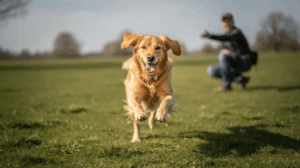
Teaching your dog to come when called is an important safety skill. The goal is for your dog to turn toward you, leave a distraction, and return within reach when you give the cue. Reliable recall takes practice, and it does not replace a leash or secure enclosure where those safeguards are needed.
Dogs may struggle with recall because distractions compete with the cue, practice has been limited to easy settings, or returning has led to something unpleasant. This guide explains how to train a dog to come when called, beginning indoors and gradually practicing outdoors under control. The approach uses rewards, manageable distractions, and consistent practice.
The short answer: Choose a clear recall cue, begin in a quiet indoor space, reward your dog for returning, and gradually increase distance and distractions. Use a securely fenced area or an appropriately handled leash outdoors. For significant fear, aggression, or sudden behavioral changes, seek veterinary assessment and qualified behavioral support.
Here’s what you’ll learn:
- What a useful recall looks like.
- How to teach the cue and practice it in gradually harder settings.
- Common mistakes that make recall less consistent.
- How to manage outdoor practice with a long line.
- How to troubleshoot incomplete or inconsistent returns.
- Which published Winston-Salem training options include recall foundations.
Understanding Reliable Recall
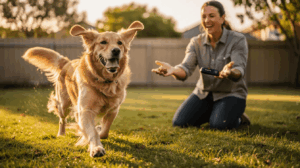
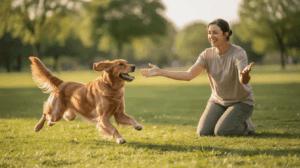
Recall means your dog returns to you when called. A useful response includes turning toward you, moving back promptly, and arriving close enough for you to attach a leash or otherwise secure the dog. Training this skill can help you manage everyday situations, but it cannot guarantee that accidents will be prevented.
Recall is useful even when your dog stays on leash. A response learned in the kitchen may not transfer immediately to a yard or another environment. Practice gradually while maintaining physical control, and check the rules for each property or public space before training there.
What “Come When Called” Really Means
Reliable recall means working toward a consistent, prompt response in the situations your dog encounters. There is no universal percentage that makes off-leash activity safe. A strong response in one setting does not eliminate the risks of traffic, wildlife, unfamiliar dogs, or unexpected distractions.
The complete response includes turning toward you, returning, and finishing within reach. A dog that approaches but stops several feet away still needs practice with the final part of the behavior.
Why Dogs Don’t Come When Called
Several factors can contribute to an inconsistent recall:
- Competing distractions: Sniffing, wildlife, play, or food may be more rewarding than returning.
- Negative associations: If recall routinely predicts scolding or an unpleasant task, your dog may become reluctant to approach.
- Repeated cues: Calling several times can make the first cue less meaningful.
- Limited practice: Indoor success may not transfer immediately to outdoor settings.
- Difficulty that increases too quickly: More distance and stronger distractions can overwhelm the response your dog has learned.
- Health or emotional concerns: Pain, hearing changes, fear, or other problems may affect responsiveness.
Never punish your dog after returning, even if the response was slow. Reward the arrival and make the next practice attempt easier.
The Foundations of a Great Recall Cue
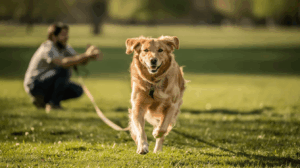
Before training outdoors, choose a consistent cue, find rewards your dog values, and set up an easy practice environment.
Choosing and Protecting Your Recall Word
Pick a clear cue such as “here” or “come,” and use it consistently. You can say your dog’s name first if that helps get attention, but the name-plus-cue sequence is not mandatory. A whistle can also become a recall cue if you teach its meaning through repeated, rewarding practice.
If your current cue has a history of being ignored or followed by unpleasant experiences, a new cue may help. Teach it in easy situations where success is likely, reward returns, and avoid scolding your dog after arrival. No setup guarantees success, so reduce the difficulty when your dog struggles.
An optional emergency recall cue must be practiced and reinforced before you need it. Simply reserving a word for emergencies does not teach a response, and even a well-trained cue cannot overcome every distraction.
Picking Rewards Your Dog Values
Choose rewards your dog values in the current setting. Kibble may work indoors, while a more distracting environment may require a more appealing dog-safe treat or favorite toy. Use small portions and account for your dog’s dietary needs.
During early practice, reward successful returns consistently. You can vary suitable rewards according to the situation. When safe, returning to sniffing or play after a recall can also help prevent the cue from always predicting the end of an enjoyable activity.
The published Basic Marker Mastery™ program uses reward-based methods and introduces come, sit, and place. Ask the team how the selected program approaches recall and owner practice.
Setting Up the Environment
Start in a quiet indoor space with your dog only a few steps away. Remove unnecessary distractions and have rewards ready before beginning.
Use brief sessions that end before your dog becomes tired, frustrated, or disengaged. A few successful repetitions are more useful than repeatedly calling after your dog has lost interest.
For outdoor practice, prepare a well-fitting harness, an appropriate leash or long line, and a suitable place to train.
Step-by-Step: How to Train a Dog to Come When Called
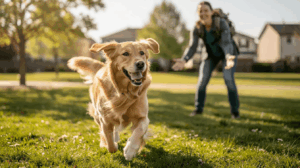
Each step builds on the previous one. Increase difficulty according to your dog’s response rather than a fixed calendar.
Step 1: Teach the Basic Recall Indoors
Start in a quiet room with your dog nearby.
- Encourage your dog to move toward you with inviting body language or a few steps backward.
- As your dog begins approaching, say the chosen recall cue.
- When your dog arrives within reach, reward with a treat, praise, or suitable play.
- Repeat a few times, keeping the exercise easy and enjoyable.
As the association develops, give the cue before your dog starts moving, without needing to show the reward first.
Reward arrival itself during this early stage. Adding a sit or down can wait until returning is clear and comfortable.
Separately pair brief, gentle collar or harness touches with rewards. When your dog is comfortable with that handling, incorporate it into the end of a recall. Do not grab or restrain a dog that backs away or shows discomfort.
For another explanation of this progression, review the AKC’s recall-training guidance.
Step 2: Add Distance and Mild Indoor Distractions
Once your dog returns eagerly from a short distance:
- Call from farther across the room.
- Practice from another room after shorter recalls are comfortable.
- Add mild distractions, such as a familiar toy nearby.
- Ask a family member to help with a recall game.
For recall ping-pong, two people take turns calling and rewarding the dog. Begin close together and increase the distance gradually.
If your dog does not respond, avoid repeatedly calling or raising your voice. Move closer, use inviting movement, and make the next attempt easier.
Hide-and-seek can also be useful once your dog understands the cue. Hide in an easy indoor location, call, and reward your dog for finding you.
Step 3: Move to a Yard or Suitable Outdoor Area
Move outdoors to a securely fenced yard or another spacious location where you can maintain control and training is permitted. Avoid driveways, traffic, crowded paths, and situations where a long line could catch on obstacles.
A long line can provide more room for practice while you maintain physical control. A 15- to 20-foot line may be manageable in a suitable open area. Use well-fitting equipment, preferably a back-clip harness, and prevent your dog from accelerating into the end of the line. The equipment reduces some risks but does not make the situation risk-free.
To begin:
- Keep your dog close and allow some relaxed exploration.
- Call when your dog is not intensely focused on a distraction.
- Reward when your dog returns.
- If your dog does not respond, maintain control, move closer, and reduce the difficulty. Encourage a return without jerking or dragging the dog.
Keep the line clear of legs, people, and obstacles. Do not wrap it around your hands or allow your dog to build speed toward its end.
Outdoor practice may require different rewards or shorter distances than indoor work. Treat the new setting as another teaching stage.
Step 4: Practice Around Manageable Distractions
Introduce distractions gradually. What is easy for one dog may be difficult for another.
Possible practice conditions include:
- A person walking at a comfortable distance.
- A familiar dog far enough away that your dog can still respond.
- Mild background activity.
- A toy or interesting scent that your dog can disengage from.
Change one major variable at a time. Increase either distance or distraction difficulty rather than both together.
If your dog repeatedly ignores the cue, increase distance from the distraction, move closer to your dog, or return to an easier setting. Better rewards can help, but they do not replace sensible management of an overwhelming situation.
The published dog obedience training programs include come and owner instruction. Board & Train curricula also include recall and distraction work, with the distraction level varying by program. Confirm the curriculum and training arrangements with the team rather than assuming particular locations are included.
Step 5: Practice Within a Secure Enclosure
Before removing the leash for practice, look for these training foundations:
- Your dog returns promptly and consistently during controlled practice.
- You have practiced in several manageable settings.
- Your dog arrives within reach.
- Your dog is comfortable with gentle collar or harness handling.
These observations do not establish that an unfenced setting is safe.
Begin any off-leash practice in a securely fenced area after checking the gates and boundaries. Hold the long line during open-area practice; a loose, trailing line can snag, tangle, or move beyond reach.
Do not use an unfenced area to test whether recall training has worked. Keep your dog physically secured where escape could lead to traffic, wildlife conflict, or other hazards. No training method or device guarantees a response or overrides the rules for that location.
Quick-reference checklist:
- Teach short indoor returns.
- Add indoor distance and mild distractions.
- Begin controlled outdoor practice.
- Introduce manageable distractions gradually.
- Keep off-leash practice within secure boundaries.
Tools and Training Methods
Long Lines, Treat Pouches, and Whistles
A long line is a management tool that lets you practice at greater distances while retaining physical control. Choose a length you can handle comfortably in the available space.
A treat pouch can make reward delivery easier. Prepare suitable rewards before the session so you can focus on your dog.
A whistle can provide a consistent sound, but it has no special meaning until trained. Pair the sound with easy returns and rewards before using it at greater distances. Its usefulness depends on the setting and your dog’s ability to hear and respond.
E-Collars and Recall Training
Some published Off Leash K9 Training Winston-Salem programs include an e-collar. The reviewed pages do not establish that every dog follows the exact introduction sequence described in generic training articles.
An electronic collar can deliver electrical stimulation. Describing the sensation as a harmless shoulder tap does not establish how a particular dog experiences it, and professional involvement does not guarantee a particular outcome.
A 2020 study comparing training approaches found that the reward-focused group performed better on several measures, including responses after a single instruction and response times. The findings did not demonstrate an efficiency advantage for e-collars. These performance measures should not be described as direct measurements of improved welfare.
Reward-based recall training does not require an e-collar. If you are comparing local programs, ask about equipment, handling, suitability, and owner instruction. The Winston-Salem FAQ states that e-collar training generally begins at five months or older; age alone does not establish readiness.
The site’s guide to e-collar training for beginners provides further discussion of methods, limitations, and owner considerations.
Common Recall Problems and How to Address Them
Your Dog Runs the Other Way
Chasing can turn an easy training exercise into a pursuit game.
In a securely enclosed practice setting, try moving a few steps away from your dog and using inviting body language. Reward the return. Avoid running toward traffic or other hazards.
Use controlled practice and a held long line outdoors so your dog cannot repeatedly escape during training.
Your Dog Comes Indoors but Not Outside
The outdoor setting may introduce stronger distractions than your dog has practiced around.
Move closer, choose a quieter location, and begin with easy returns. Keep sessions brief and maintain physical control.
When safe, reward and release your dog back to exploring. Recall does not need to end every enjoyable activity.
Your Dog Comes Slowly or Stops Out of Reach
Practice the final part of the return separately.
- Reward arrivals close to you.
- Teach a hand target if it helps give your dog a clear destination.
- Pair gentle collar or harness touches with rewards.
- Sometimes reward, briefly touch the equipment, and release your dog back to an appropriate activity.
Do not reach suddenly or grab a dog that avoids handling. If the dog shows fear, discomfort, or aggression, seek appropriate assessment.
Your Dog Used to Come and Suddenly Stopped
Recall can become less consistent when distractions, routines, or environments change. If the change is sudden or your dog seems uncomfortable, confused, or less responsive to sounds, contact your veterinarian rather than assuming stubbornness or adolescence.
Return to easier practice conditions while you assess what changed.
You can compare Board & Train programs with private lessons if you need structured support. Program duration is not a guaranteed recall-development timeline, and owner practice remains necessary.
Conclusion and Next Steps
Recall develops through consistent practice, appropriate rewards, and manageable training conditions. Progress varies, and some dogs need additional assessment or support. Keep physical safeguards in place while building the skill.
Start with these steps:
- Choose a consistent cue.
- Practice a few short returns indoors.
- Reward arrival within reach.
- Teach comfortable collar or harness handling separately.
- Add distance and distractions gradually.
- Use a held leash or long line outdoors, or practice within a secure enclosure.
Off Leash K9 Training Winston-Salem offers obedience programs that include come or recall, depending on the selected curriculum. Call (336) 600-1885 or request a free phone consultation to discuss your dog’s needs and available options.
Frequently Asked Questions
How Long Does It Take to Train a Reliable Recall?
There is no universal timeline. Progress depends on the dog’s learning history, health, distractions, and consistency of practice. An indoor response does not establish readiness for more difficult settings. Published program durations describe the training format, not a guaranteed deadline for reliable recall.
When Can I Safely Let My Dog Off Leash?
Start off-leash practice only in a securely enclosed area where it is permitted. No success percentage guarantees safety outside an enclosure. Check the current rules for the specific property or public space, and keep your dog leashed where required or where an escape would create danger.
Can Puppies Learn to Come When Called?
Yes. Puppies can begin gentle recall games when they come home, using short distances and appropriate rewards. Early practice does not guarantee prevention of later problems. The published puppy training options include early obedience foundations; confirm the curriculum and eligibility for your puppy.
Should I Use Recall for Things My Dog Dislikes?
Avoid making recall consistently predict unpleasant tasks or the end of every enjoyable activity. Arrange routine care without relying on the main recall cue, and work separately on making handling comfortable. When you do call your dog, reward the return.
What If My Dog Already Ignores the Recall Word?
A new cue may help if the old one has an unclear meaning or negative associations. Begin at close range in an easy setting, reward returns, and increase difficulty gradually. A trainer can help assess the problem.