
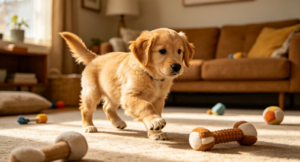
A thorough puppy proofing checklist is one of the most important preparations you can complete before your new puppy arrives home. In 2025, ASPCA Poison Control received calls involving pets exposed to more than 376,000 potentially toxic substances and assisted over 334,000 animals. Puppy-proofing your home can reduce the risk of preventable exposures and other household accidents. ASPCA’s 2025 report identifies medications, food and drinks, chocolate, plants, household products, and pesticides among the most frequently reported toxin categories.
This guide covers indoor and outdoor safety measures room by room, giving every new puppy owner, whether in the Winston-Salem area or anywhere else, a practical, actionable framework. It does not cover advanced behavioral modification or breed-specific medical concerns, but it does bridge the gap between physical safety and the early training foundations that help keep your four-legged friend out of harm’s way.
A comprehensive puppy proofing checklist includes securing hazardous items, blocking dangerous areas, removing or restricting access to toxic substances, and creating designated safe spaces throughout your home and yard. Designate specific areas for your puppy to play, and establish a routine for feeding and potty breaks from day one.
By following this guide, you will:
- Reduce poisoning risks by identifying and securing toxic foods, medications, plants, and cleaning supplies
- Remove potential choking hazards by keeping small objects out of your puppy’s reach
- Reduce electrical risks by managing cords and outlets in every room
- Create secure boundaries indoors and outdoors so your pup can explore more safely
- Improve emergency preparedness with veterinary contacts, supplies, and a first-aid plan
Understanding Puppy Safety Fundamentals
Puppy proofing means systematically modifying your household and yard to account for a puppy’s natural behaviors, including chewing, mouthing, climbing, digging, and swallowing objects that an adult dog might ignore. Think of it as child-proofing with sharper teeth and faster legs. Young puppies are naturally curious and energetic, which means they will investigate their surroundings using their mouths and noses.
Proper preparation is not just about preventing emergencies. It also gives your puppy a safer environment in which to learn household routines and appropriate behavior. Removing hazardous items can reduce opportunities for poisoning, choking, electrical injury, and foreign-object ingestion, but supervision and training are still necessary because chewing is a normal puppy behavior.
This structured environment supports early routines whether you’re working on potty training or introducing basic household boundaries.
Age-Specific Risk Factors
Young puppies require close supervision because mouthing, chewing, limited coordination, and immature impulse control make ordinary household items risky. Teething-related chewing often becomes more noticeable at approximately 12 weeks, when baby teeth begin falling out and permanent teeth start erupting. It may continue until the adult teeth are in place at approximately 6 to 7 months.
Risk varies according to the individual puppy’s size, development, temperament, and environment rather than one fixed age range. VCA Hospitals’ teething guide provides additional information about this timeline.
Puppies may also climb onto furniture, squeeze through small gaps, or bolt through an open door or gate. Small items such as coins, batteries, rubber bands, paper clips, and jewelry can cause choking, chemical burns, or digestive obstruction.
The severity of a toxic exposure depends on the substance, amount consumed, and puppy’s size and health. Contact a veterinarian or animal poison-control service promptly if you suspect an exposure rather than waiting for symptoms.
Indoor vs. Outdoor Hazard Categories
Indoor hazards fall into predictable categories: ingestible toxins such as foods, medications, and cleaning supplies; choking or blockage risks such as small objects, batteries, and clothing; and physical injury risks such as electrical shock, burns, or falls down stairs. Many exposures involving human medications, household products, and toxic foods occur inside the home.
Outdoor dangers introduce less predictable variables. Toxic plants, unsecured fencing, water hazards such as in-ground pools, wildlife encounters, and lawn-care chemicals can all pose risks that change with weather and seasons. In North Carolina’s Piedmont region, hot summer conditions increase the risk of overheating, while heavy rain and storms can damage fencing or leave debris in the yard.
The key takeaway is that indoor spaces offer more control but contain many overlooked hazards, while outdoor areas demand ongoing vigilance because conditions change. Both require systematic attention, which is why a room-by-room indoor approach is the most reliable starting point.
Essential Indoor Puppy Proofing Areas
Indoor puppy proofing tips work best when you approach them systematically, one room at a time. Set up an indoor playpen to provide a safe area for your puppy in the room where you spend the most time, and then work outward.
Use baby gates to confine your puppy to carefully prepared zones while you audit each space. The goal is to make every puppy area a place where your new family member can explore with fewer opportunities to encounter hazards.
Living Room Safety Measures
The living room is where your dog may spend a significant portion of each day, and it is often the room with the most overlooked dangers.
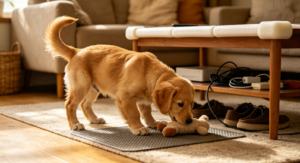
Electrical cord management is a priority. Puppies that chew electrical cords can experience mouth burns, electrical shock, or other serious injuries. Route cords behind furniture, unplug nonessential electronics, and use sturdy cord covers or protective tubing where cords cannot be removed.
Install outlet covers on exposed sockets and prevent your puppy from accessing damaged cables. Preventive Vet’s puppy-proofing checklist also recommends concealing cords and providing appropriate chew toys.
Furniture and fireplace safety requires anchoring heavy pieces that could tip if climbed on or pulled. Gas and wood-burning fireplaces need secure screens or barriers. Use sturdy baby gates to block stairs or unsafe rooms, and cover gaps in stairway railings where a small pup could slip through. Non-slip rug pads can also reduce movement on slick floors.
Decorative items and small objects are a constant concern. Remove coins, small toys, paper clips, rubber bands, jewelry, and knickknacks from floors and low surfaces. Batteries are especially dangerous because they can cause chemical burns if punctured or swallowed.
Regularly check accessible areas for choking hazards. Raise or secure blind and curtain cords well above your puppy’s reach to prevent entanglement or strangulation.
Kitchen Hazard Control
The kitchen is one of the highest-risk rooms in any home. The smells coming from counters and trash cans make it particularly interesting to puppies.
Chemical storage requires careful attention. Keep cleaning supplies such as bleach, ammonia, degreasers, dishwasher products, and oven cleaners in closed cabinets that your puppy cannot access. Use child-resistant cabinet locks where necessary, and follow all product-label storage and usage instructions.
Never mix cleaning products. Keep puppies outside the area while strong cleaning products are being used, and securely store sharp objects such as knives and scissors.
Food safety is vitally important. Chocolate can cause serious poisoning, with risk depending on the type and amount consumed and the dog’s body weight. Xylitol, which is found in some sugar-free gums, candies, baked goods, dental products, and medications, can cause a rapid drop in blood sugar and other severe effects in dogs.
Grapes, raisins, onions, and garlic can also be dangerous. These foods are included among common food-related exposures in the ASPCA’s 2025 toxin report. Food and drink represented 16.4% of reported exposures, while over-the-counter products accounted for 16.9%.
Store food in closed cupboards, refrigerators, or secure containers. Do not assume that a sealed wrapper or lightweight container will prevent a determined puppy from reaching the contents.
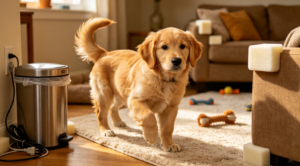
Trash-can security is essential. Use a locking trash can or store the bin inside a cabinet or behind a closed door. Garbage can expose puppies to bones, spoiled food, toxic ingredients, wrappers, sharp items, and bags that may cause suffocation.
Bedroom and Bathroom Precautions
Bedrooms and bathrooms contain concentrated clusters of hazards that puppy owners can easily overlook.
Medications and supplements are a major concern. Store prescription medications, over-the-counter products, vitamins, and supplements in closed cabinets that your puppy cannot access. Avoid leaving them on bathroom counters, nightstands, or inside purses and backpacks placed on the floor.
Flavored supplements and medications may be especially attractive to dogs. If medication is dropped, locate and retrieve it before allowing your puppy into the area.
Bathroom-specific dangers include toilet water, cleaning products, razors, dental floss, cotton swabs, and grooming products. Keep toilet lids closed to prevent drinking, chemical exposure, or a small puppy falling inside. Close the bathroom door when the room is not in use.
A puppy may also unravel and swallow toilet paper, tissues, or sanitary products, potentially causing digestive problems or an obstruction. Store these items securely.
Laundry and clothing hazards are frequently underestimated. Socks, underwear, dryer sheets, and pieces of fabric can cause intestinal obstruction if swallowed. Keep laundry in a closed hamper and prevent access to detergent pods, liquid detergent, fabric softener, and other laundry products.
Closets and small spaces under furniture or behind beds can trap a small puppy. Block unsafe gaps and check reclining furniture before operating it.
For overnight safety, place your puppy’s crate in a quiet, climate-controlled area away from extreme heat, cold, and direct drafts. Proper crate training supports safe rest and limits nighttime access to household hazards. Keep windows securely closed or screened so your pup cannot push through.
Emergency Preparedness
Puppy proofing lowers risk but cannot eliminate every emergency. Prepare before your puppy arrives by saving the contact details for:
- Your regular veterinarian
- The nearest emergency veterinary hospital
- ASPCA Poison Control at (888) 426-4435
- Another veterinary poison-control service recommended by your veterinarian
Keep a puppy first-aid kit in an accessible location and include basic supplies recommended by your veterinarian. Maintain copies of vaccination records, medication information, microchip details, and relevant medical history.
If your puppy may have swallowed something toxic, do not induce vomiting or administer a home remedy unless a veterinarian or poison-control professional specifically instructs you to do so. Save the product packaging and note the substance, possible amount, and approximate time of exposure.
Outdoor Safety and Yard Preparation
Once indoor spaces are secured, turning your yard into a puppy-safe playground is the next critical step. Outdoor environments introduce variables you cannot fully control, but a thorough yard assessment can reduce common dangers.
For Winston-Salem owners, summer heat, heavy rain, storm debris, and possible damage to fencing make regular outdoor inspections especially important.
Yard Security Assessment
Confirm that the yard is securely contained with no holes in the fence. Inspect fencing from your puppy’s height to identify gaps that might not be obvious when standing.
- Inspect the entire fence perimeter. Check for holes, loose panels, rotting boards, sharp edges, or areas where a small pup could crawl underneath. Repair unsafe gaps with appropriate fencing material.
- Test all gate latches. Add locks or self-closing mechanisms if needed. Inspect gates after storms, maintenance work, deliveries, or visits from other people who may have opened them.
- Check for toxic plants. Use the ASPCA Toxic and Non-Toxic Plant Database to identify plants correctly because toxicity and severity vary considerably.
Sago palms can cause liver failure and death in dogs, while azaleas and oleander can also cause serious poisoning. Philodendrons more commonly cause painful irritation of the mouth and gastrointestinal tract, with severe throat swelling occurring rarely. Remove toxic plants or place them behind secure barriers your puppy cannot access. - Secure pools and water features. Fence in-ground pools and ponds to reduce the risk of accidental drowning. Cover open drains and prevent unsupervised access to fountains, buckets, rain barrels, and other water containers.
- Store garden chemicals and tools. Secure fertilizers, pesticides, rodenticides, antifreeze, fuel, and sharp tools inside a locked shed, garage cabinet, or other inaccessible location. Follow product-label instructions, including any required waiting period before allowing pets onto a treated lawn.
Keep the lawn and brush maintained to reduce tick habitat, and remove thorns, sharp branches, mushrooms, animal waste, and storm debris. During warm weather, provide shade and fresh water and limit outdoor activity when temperatures are unsafe.
Supervision vs. Independence Comparison
There is no fixed age when every puppy becomes safe outside alone. Use this comparison to determine the appropriate level of oversight for your individual puppy and property:
| Criterion | Directly Supervised Outdoor Time | Short-Duration Independent Access |
| Suitability | Recommended for young puppies and dogs new to the home | Consider only after evaluating the individual dog and yard |
| Supervision | Adult present with a direct line of sight | Frequent checks and a secure enclosure are still required |
| Safety Measures | Leash, exercise pen, or secure fenced area | Escape-proof fencing, no accessible toxic plants or chemicals, no open water, and safe weather conditions |
| Training Role | Opportunity to teach recall and boundaries | Training does not replace physical containment |
| Identification | Registered microchip and properly fitted identification tag | Registered microchip and properly fitted identification tag |
Young puppies should be directly supervised, and some yards may never be appropriate for unsupervised access because of wildlife, weather, theft, escape routes, pools, or nearby hazards.
Puppy training can strengthen recall and boundary skills, but these behaviors do not replace secure fencing and appropriate supervision.
Common Challenges and Solutions
Even the most prepared new puppy owner will encounter obstacles. Welcoming a new dog into your home is a significant responsibility, and the following challenges are among the most common.
Persistent Chewing Despite Deterrents
Chewing is biologically normal during teething. You may not eliminate it, but you can redirect it toward safer alternatives.
Provide appropriately sized puppy chew toys selected for your pup’s age and chewing style. Supervise rope toys and tennis balls, and remove them if fibers, rubber, or other pieces begin coming loose. Remove any toy that becomes small enough to swallow.
Bitter deterrent sprays may discourage chewing on some surfaces, but they should never replace cord covers, barriers, unplugging, or direct supervision. Test sprays on a small hidden area first and follow the product instructions. Age-appropriate physical activity and mental enrichment can also help reduce boredom-related chewing.
If destructive chewing persists despite appropriate chew outlets, environmental management, rest, and enrichment, consult your veterinarian to rule out pain, dietary concerns, anxiety, or other contributing factors.
A professional puppy training consultation can also help owners establish clearer routines, reinforce appropriate choices, and manage unwanted chewing. Training supports household safety, but it does not replace physical puppy proofing or supervision.
Puppy Escaping Secured Areas
If your puppy is getting past baby gates or through fencing, the barriers need physical upgrades. Increase the height of barriers when necessary, close gaps at ground level with appropriate fencing materials, and ensure gates latch securely.
Consider a double-gate system, consisting of an interior barrier and the main gate, to create an additional layer of protection. Check that gates close automatically and that family members, contractors, and visitors understand the gate rules.
Inspect the perimeter after severe weather or yard maintenance because fence boards, gates, or ground-level barriers may shift. A motion-detection camera can help identify where and how escape attempts occur, but it should supplement rather than replace physical inspections.
Family Members Not Following Safety Rules
In multi-person households, inconsistent safety practices can weaken puppy proofing. When one person closes the bathroom door but another leaves it open, or when visitors place purses containing medications on the floor, the puppy may gain access to hazards despite the household’s usual precautions.
Hold a household meeting to establish written guidelines such as:
- Keep medications, bags, and food off the floor
- Close bathroom, laundry, and exterior doors
- Check gates before letting the puppy outside
- Store trash and cleaning products securely
- Supervise access to chew toys
- Follow the same crate, feeding, and potty routines
Post the rules somewhere visible and explain them to regular visitors. Consistent dog obedience training can help family members reinforce the same boundaries, but everyone must also follow the physical safety rules.
Conclusion and Next Steps
Thorough puppy proofing can reduce the risk of poisoning, choking, escape, electrical injury, and other preventable accidents. It also creates a more manageable environment where your new family member can begin learning household routines.
Puppy proofing is not a one-time task. Recheck your home and yard as your puppy grows, becomes more mobile, and develops new chewing or climbing abilities.
Your immediate action plan:
- Complete the room-by-room checklist before your puppy arrives whenever possible. View every room from puppy height and remove, block, or securely store anything your puppy could chew, swallow, pull down, or become trapped inside.
- Purchase essential safety supplies. Useful items may include cord covers, baby gates, cabinet locks, locking trash cans, an exercise pen, appropriately sized chew toys, and veterinary-approved first-aid supplies.
- Request a free consultation. A puppy training consultation can help pair physical proofing with household routines and behavioral foundations.
Once your home is secured, the next priorities are crate training, potty training with consistent potty breaks, and early puppy socialization. Each of these builds on the safer foundation created by your puppy proofing checklist.
Frequently Asked Questions
How does puppy proofing help with potty training?
Puppy proofing creates a safer, more controlled environment that supports consistent potty training routines. Using gates or an exercise pen limits unsupervised access to the house and makes it easier to notice when your puppy needs a potty break.
Puppy proofing cannot eliminate accidents, but it can make supervision and routine management more effective.
What should I consider regarding my puppy’s neck when puppy proofing?
Secure blind cords, curtain ties, cables, loose straps, and other items that could wrap around your puppy’s neck. Check the puppy’s accessible area from floor level and remove anything that creates an entanglement or strangulation risk.
Make sure collars fit properly, and do not leave a puppy tethered or attached to a leash without direct supervision.
How can I prevent my puppy from chewing electrical cords?
Place electrical cords behind furniture, unplug nonessential equipment, and use sturdy cord covers or protective tubing. Block access to areas where cords cannot be safely concealed.
Appropriate chew toys can redirect chewing, but they do not replace physical cord protection and supervision.
What types of plants should I remove from my home and yard?
Remove or securely block access to plants identified as toxic to dogs, including sago palms, oleander, azaleas, and certain other species. Philodendrons can cause painful mouth and gastrointestinal irritation, while true lilies are particularly dangerous to cats rather than uniformly causing severe poisoning in dogs.
Verify each plant through the ASPCA Toxic and Non-Toxic Plant Database.
How do I secure trash cans to keep my puppy safe?
Use a sturdy trash can with a locking lid or store the bin inside a latched cabinet or behind a closed door. Lightweight lids may not stop a curious puppy.
Regularly empty trash containing bones, spoiled food, toxic ingredients, medication packaging, sharp items, or plastic bags.
When is it safe to allow my puppy unsupervised outdoor access?
There is no universal age when outdoor access automatically becomes safe without supervision. Young puppies should be directly supervised, and older puppies still need a secure fence, protection from toxic plants and water hazards, safe weather conditions, identification, and frequent monitoring.
Reliable recall and boundary awareness are helpful, but they do not replace secure containment.